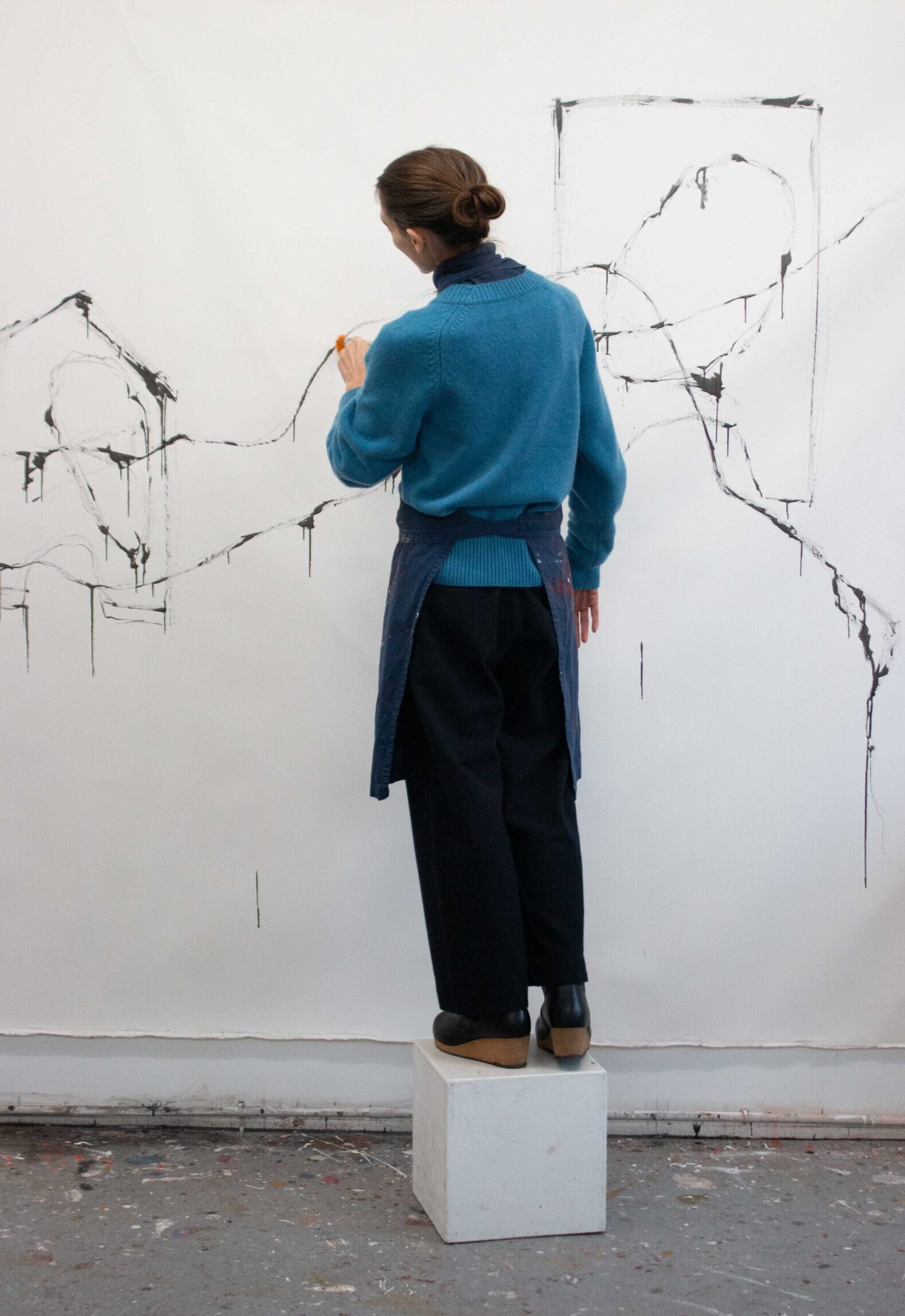
Artistic approach
My approach is intuitive, meaningful, spiritual, far from the hustle and bustle, solitary, and my creations offer a moment to step back and reflect.
They are a mirror of our society through the prism of my own concerns.
I address place, the imprint of time, ecology and the connection between humans and their natural or built environment.
It is based on a long-standing exploration of the relationship between constructed environments and organic matter, and bears witness to the experiences that have shaped my personal journey, my subtle connection with the non-human elements that surround us. A relationship that has developed through my past professions and sources of inspiration, enriching my perception of life.
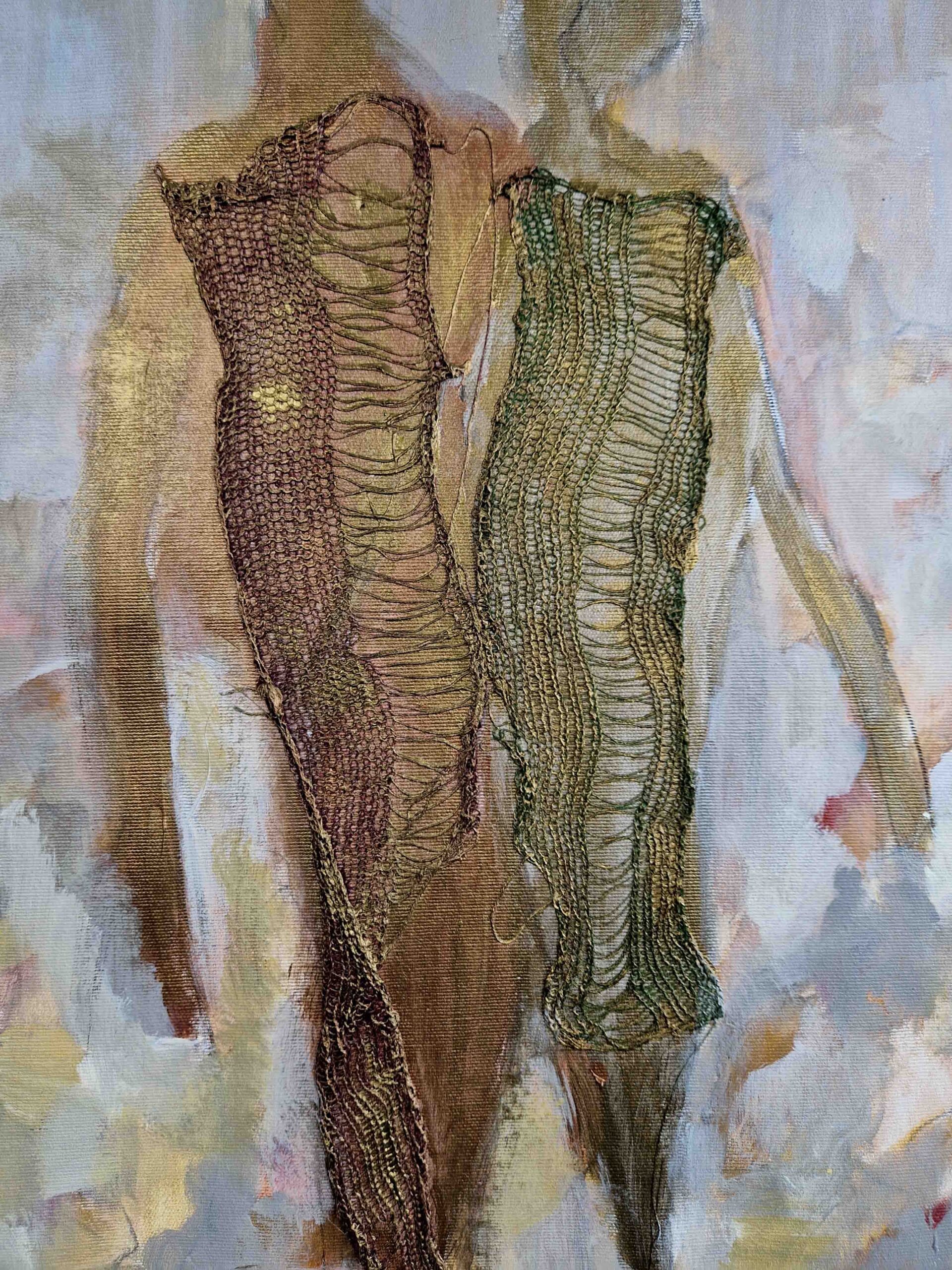
Life of a body
Inspired by buried and imaginary memories, by what infuses me when I interact with spaces, my creations reflect the physicality of our environment, the relationship between the human and the non-human, such as societal pulses or vibrations.
Through a carnal and intuitive dialogue with matter, I study how mineral, plant, organic and architectural flesh interweave like traces belonging to different temporalities.
In an almost geological process of stratification, steel mesh, rope, canvas, pigment and clay become bodies, ruins, landscapes or topographies. Knotted, stretched or braided rope proliferates like a plant, hinders like a corset, gangrenes or rebuilds.
These environmental bodies evoke life in transformation. Painted, sculpted, modeled, they blur the boundaries between nature and architecture, sculpture and skin. Made up of successive layers, they are flexible, rigid, and dense, questioning the immediacy of a world that mirrors the delicacy of screens.
By recomposing architectural remains, fragments of nature, and body shreds, I seek to weave links between living beings.
I express states between vitality and decline, between destruction and repair, between life and death, and reflect the restorative power of the relationship between living beings, inhabited places, and natural spaces. The connection between biodiversities offers potential for healing, mutual transformation and opens up the possibility of new life.
My work addresses place, the imprint of time, ecology and the connection between humans and their natural or built environment.
It is based on a long-standing exploration of the relationship between constructed environments and organic matter, and bears witness to the experiences that have shaped my personal journey, my subtle connection with the non-human elements that surround us. A relationship that has developed through my past professions and sources of inspiration, enriching my perception of life.
Life of a body
Inspired by buried and imaginary memories, by what infuses me when I interact with spaces, my creations reflect the physicality of our environment, the relationship between the human and the non-human, such as societal pulses or vibrations.
Through a carnal and intuitive dialogue with matter, I study how mineral, plant, organic and architectural flesh interweave like traces belonging to different temporalities.
In an almost geological process of stratification, steel mesh, rope, canvas, pigment and clay become bodies, ruins, landscapes or topographies. Knotted, stretched or braided rope proliferates like a plant, hinders like a corset, gangrenes or rebuilds.
These environmental bodies evoke life in transformation. Painted, sculpted, modeled, they blur the boundaries between nature and architecture, sculpture and skin. Made up of successive layers, they are flexible, rigid, and dense, questioning the immediacy of a world that mirrors the delicacy of screens.
By recomposing architectural remains, fragments of nature, and body shreds, I seek to weave links between living beings.
I express states between vitality and decline, between destruction and repair, between life and death, and reflect the restorative power of the relationship between living beings, inhabited places, and natural spaces. The connection between biodiversities offers potential for healing, mutual transformation and opens up the possibility of new life.
Text written by Pauline Lisowsky, 2024
Building, repairing, restoring life to bodies
Aude Borromée’s artistic work stems from a deep-rooted process of connecting her body with a support and materials of the construction kind. Painting is the artist’s first means of expressing memories and vivid images from her attentive walks. In her canvases, colors come together in a process of stratification and overlapping, expressing the fragility of the environments we inhabit and a certain vitality: the urgency to act. An architectural ruin appears, sketched in ink, fragments of buildings, a world in the grip of a devastating phenomenon.
The body, whether human, animal, vegetable or architectural, is at the heart of her artistic approach. The artist dialogues with her material, a chicken wire that is both malleable and rigid. By folding and twisting, she creates a volume, like a body, from which images of living organisms, landscapes and geological formations can emerge. She uses millimeter-diameter rope with great freedom, developing a vocabulary of knots and torsions, with which she creates interactions with wire mesh. These two materials, both links, seem to support or need each other. Her sculptures are like structures that hold together, yet are on the verge of collapse. They evoke a process of vitality, repair and proliferation.
In some sculptural works, the woven, bound and knotted rope is the image of a living being in the process of colonizing a natural space, an environment (Lichens). In others, the mesh builds outgrowths or cells (Shelters). In still others, the forms are reminiscent of the modeling of a natural material. A process of transformation and regeneration emerges, as if nature were meeting the built environment. A movement between opening and closing, between extension and compression, like the expression of a vital breath is felt in front of his works… A parietal dimension, an energy, telluric forces are also expressed. The artist tends to pursue the phenomenon of metamorphosis within her works. She envelops her sculptures and creates their imprints, witnessing a situation, a posture, an interaction, a presence with an environment, traces embodying the past of a territory.
In the series Architected bodies and their remains, Aude Borromée confronts a lacquered steel plate with a wire mesh, inserted into an opening. Through a variety of stitches created with her rope, the sculptor generates and develops a conglomerate of materials. A new skin covers this architectural fragment. These sculptures express the process of restoration, the work of man or the growth of plants that cling together to reinforce a bald facade. Inspired by relics or altars, a counterpart is a sublimated vestige, the memory of a residue that bears witness to history. This artistic work is akin to an attempt to preserve what has been and to offer support to this fractured element.
Her works in clay reveal the emergence of constructions and reconstruction sites. They form a whole, like a village in the making…
In short, Aude Borromée’s works suggest a life in latency, a state between ruin and reconstruction, a cycle of transformation, a becoming. They are at one with the space in which they are displayed.
Interview by IconIcon Media
In the studio